Search This Blog

Showing posts with label Berossus. Show all posts

Tuesday, March 2, 2010

Berossus by Polyhistor

The following is an extract on Berossus by Polyhistor.
While polyhistor is a term which refers to a person who has a vast base of knowledge in this case it refers to a person named Lucius Cornelius Alexander Polyhistor who lived in c. 100 BC. Lucius Cornelius was a Roman philosopher, geographer, and historian, amongst other things. He was born in Miletus. According to wikipedia Alexander Polyhistor was born a Greek and became a scholar. He earned the title polyhistor due to his productivity in recording historical events.
The Mithridatic War came along and Alexander was captured and became a Roman slave. He was later sold to Cornelius Lentulus who wanted him as a tutor. From here he earned his freedom and returned to a freedman life as a Roman citizen. He died in a house fire and most of his writings have been lost.
This fragment is called Extract from Berossus by Alexander Polyhistor.

There was a time when all was darkness and water, and from the midst thereof issued spontaneously monstrous animals and the most peculiar figures: men with two wings, and others with four, with two faces or two heads, one of a man, and the other of a woman, on one body, and with the two sexes together; men with goat's legs and goat's horns, or with horses's hoofs; others with the hinder parts of a horse and the foreparts of a man, like the hyppocentaurs. There were, besides, human headed bulls, dogs with four bodies and fishes' tails, horses with dog's heads, animals with the head and body of a horse and the tail of a fish, other quadrupeds in which all sorts of animal shapes were confused together, fishes, reptiles, serpents, and every kind of marvelous monster presenting the greatest variety in their shapes, representations of which may be seen in the paintings of the temple of Belos. A women named Omoroca ( Um-Uruk, " the mother of Uruk"), presided over this creation; in the
Chaldean language she bears the name of Thavatth ( Tiamat ), signifying in Greek " the sea," and she is also identified with the moon.

Things being in this condition, Belos (Bel-Marduk) came upon the scene and cut the women in half; of the lower part of her body he made the earth, and of the upper half he made the heavens, and all the creatures that were in her disappeared. This is a figurative way of explaining the production of the Universe and of the animated beings from humid matter. Belos then cut off his own head, and the other gods having kneaded the blood flowing from it with the earth, formed men, who by that means were gifted with understanding, and made participants of divine thought.

[Thus it was that] Belos, interpreted by the Greeks as signifying Zeus, having divided the darkness, separated the heavens and the earth, and ordered the world : and all the animated beings who were not able to handle the action of light perished. Belos seeing that the earth was a desert, though fertile, commanded one of the Gods to cut off his head, and kneading the blood which flowed with earth, he produced men, as well as those animals who are able to live in contact with the air. - Then Belos also formed the stars, the sun, the moon, and the five planets. - ( Ap. Syncell., p. 29; Euseb., Chronic Armen. [ I., 2, 4], p. 10, ed, Mai ; Fragment 1 of my edition. )
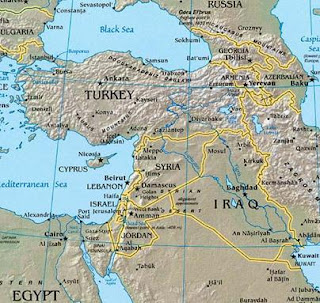


Modern map
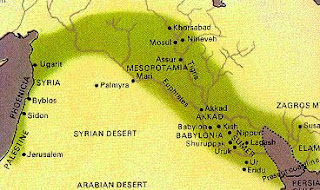
old map showing mesopotamia and babylonia
The Chaldean were settled near Sumer and were considered to be highly skilled magician or sorcerers. They ruled Babylon for a time after settling the area starting in c. 650 BC.


Click on the tags for more......


This extract is found in a book by Francois Lenormant called The beginnings of History which is public domain and written in the 1880's.

Lenormant was a french Parisian archeologist and assyriologist who followed in his fathers footsteps and who was an Egyptologist.

Another book worthy of thought by Lenormant goes into Chaldean Magic and the ancient history of the east.

Monday, March 1, 2010

Who was Berossus

Berossus was a priest of Bel in the Greek Hellenistic period (c. 332BC to c. 100 BC ). This is the time when Alexander the Great conquers Persia and Egypt but dies and leaves is territories to be split amongst his generals.

Ptolemy I Soter inherits Egypt and goes on to invent an Egyptian/Greek god called Serapis.

Berossus meanwhile is a writer, astronomer, astrologer, and historian who is studying the Enima Elish and king lists dated back to pre dynastic Egypt and as far back as he can find. Berossus is living in Babylon and Alexander the Great has also conquered Babylon. He is recording his findings in the Greek language. It isn't completely certain why these history studies by the Bel priest Berossus were undertaken but some sources state that likely it was a commission from Antichios I Soter who wanted to know more about his newly acquired land where Bel/Marduk cults were the custom.

From Babylon where he is ruled by Antiochus I Soter, Berossos is believed to have relocated to Kos in Asia Minor which would have placed him under the rule of Ptolemy I Soter. Here he sets up a school of astrology ( not well documented).

What is a priest of Bel ?

The Chaldean priest of Bel is a powerful figure in the Akkadian/ Sumerian social caste.

When the earliest civilizations were founded c. 3500 BC in this region of the Tigris and Euphrates rivers, priest-kings were the norm. These high order priests were full of knowledge and they could sometimes be gifted healers with seemingly miraculous powers. But this priestly role as ruler diminished over time with the ongoing battles. With time the priest class is one step below the elitist king who may or may not be a priest.

Marduk is a Sumerian word which is the equivalent of the Akkadian word AMAR UTU which signifies "solar calf" ( this is interesting when it is correlated to the Apis Bull of Egypt story). Marduk was by some accounts the son of the Akkadian god Ea ( Ea to the Sumerian was Enki). Marduk is often depicted as riding on a dragon.

Enlil is another god figure who is higher up the pantheonic ladder than Marduk in the old Sumerian world. Enlil is recognized as the only god who had the ability to reach the heavenly god An. Enlil became known as father of the gods or king of kings for this unique gift of divinity.

Enlil was by some accounts cast out of the heavenly realm of the Gods, a place called Dilmun, to an underworld called Kur. Is exile was a punishment for having raped Ninlil who was a goddess and got her pregnant. Ninlil meanwhile had to follow him into the underworld of Kur where Nergal/Sin was born.

Nippur becomes a major cult center devoted to Enlil. Nippur is also Nibbur or Nibru. Nippur is a major city in the later Hebrew exodus story where Moses and Lot (c. 2000 BC) lead the righteous out of Egypt in order to relocate to Canaan the promised land.

Interestingly, correlations can be made between Ki, the Sumerian goddess of the earth, and An, the Sumerian god of the Heavens, and Canaan. Kinahhu and other variations are Sumerian roots for the Hebrew word Canaan.

By the c. 1550 BC Marduk is well established as the pantheon leader of the Babylonian order.

Bel is a word which signifies lord or master. More than a name, Bel is a title which became used extensively with the Marduk cults. Bel Marduk.

Bel is to the Greeks, Belos, and to the Latin Romans, Belus.

It is a word found in belial which is a reference to one of the seven princes of hell. Bel is also Ba'al.

So is a Bel priest a satanist since the word seems to be connected to serpents, dragons, and dark lords who seem to have lost the respect of their heavenly forefathers ?

Bel and the Dragon is an ancient manuscript which was an extension of the Book of Daniel and originally written in Aramaic ( forerunner of the Hebrew language) sometime around 200 BC.

Somehow it never made it into the Bible compendium of holy texts. It seems the story of Bel and the Dragon was deemed apocryphal ( having esoteric or hidden meaning ).

" The king has become a Jew; has destroyed Bel, and has killed the Dragon, and slaughtered the [Bel] priests..."

In 300 BC Berossus is a Bel priest writing an history of the Mesopotamian evolution of kings. He isn't overly popular and most of his works end up destroyed.

At one point Ba'al (Bel) is a title given to Hadad, the son of El, a primary God of the Pagan Canaanite pantheon.


See more on Berossus at wikipedia.
Bookmark and Share